
Views
Transforming the Corporate Action Processing Lifecycle with Real-Time Connectivity
The growing volume and complexity of corporate actions are straining existing systems within the corporate action processing lifecycle. One Swift analysis found that “asset managers often receive notifications from up to 100 different sources about the same corporate event, and the data is often different or contradictory from one source to another.”
This inefficiency is not only frustrating; but it’s also expensive. Industry research estimates that corporate action notification processing costs the U.S. financial services sector around $400 million annually, largely due to manual intervention, fragmented sources, and the need to reconcile discrepancies
Modernising the lifecycle can resolve these issues and improve outcomes from corporate action processing.
By identifying risks in legacy workflows, organisations can better understand how modern tools and best practices enhance governance, improve efficiency, and ensure greater reliability across the lifecycle.
What is the corporate action processing lifecycle?
Let’s begin by defining corporate actions: corporate actions are events initiated by a company that bring changes to its securities or affect its shareholders. They fall into three main categories:
• Mandatory Actions are initiated by the issuer and applied automatically at the company level. Shareholders are not required to take action for the event to be processed, although they may receive notifications or confirmations. Example: a stock split or dividend payment. If a company executes a stock split, shareholders’ holdings are adjusted automatically based on their position on record date, with no response required from individual investors.
• Voluntary Actions require shareholders to actively decide whether to participate. Investors must submit an election, either to participate or to decline, within a defined deadline. If no response is received, the default outcome (often non-participation) will apply. Example: Rights issues, tender offers, and exchange offers, where shareholders must explicitly confirm their election to ensure correct processing.
• Informational Actions do not require any response from shareholders and do not directly alter securities positions. However, they provide important updates that may influence investment decisions or stewardship activity. Example: Company name changes or changes to meeting dates.
The corporate action processing lifecycle represents the complete journey of these events from the initial announcement by the issuer to the final settlement and crediting of proceeds. This structured process intends to ensure corporate action events are executed efficiently, accurately, and within regulatory standards. However, efficiency, accuracy and regulatory compliance are difficult to achieve with traditional systems.
In many cases, digital solutions like Proxymity are helping global custodians, brokers, and issuers to modernise corporate action processing lifecycle workflows.
7 Stages of the Corporate Action Lifecycle
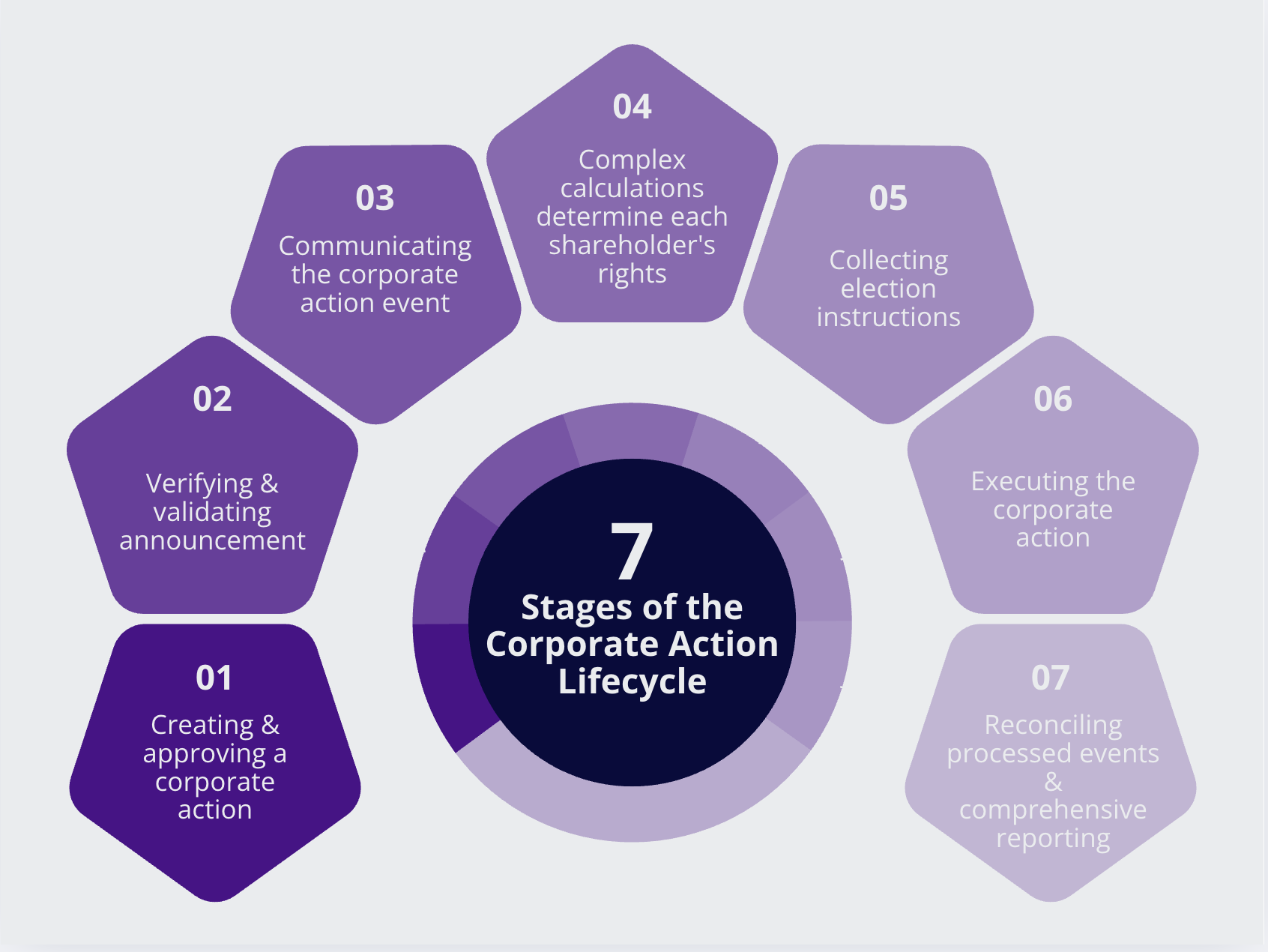
The lifecycle represents a series of interconnected stages that require precise coordination across multiple stakeholders. Each of these stages presents unique challenges and opportunities for modernisation that can deliver straight-through processing in real time.
1. Event Creation by Issuer: The lifecycle begins when an issuer’s board approves a corporate action, determining key terms including event type, ratios, pricing, and critical dates.
2. Data Scrubbing/Validation: This critical stage involves verifying announcement accuracy, checking completeness, and standardising formats. Manual methods may lead to the introduction of errors.
3. Announcement Dissemination: Corporate actions are communicated to the market and custody chain through multiple approved channels. At this stage, inconsistent formats and manual interpretations can introduce additional errors or lead to missed connections.
4. Entitlement Calculation: Complex calculations, such as applying event ratios and handling fractional shares, determine each shareholder’s rights based on holdings as of the record date.
5. Instruction Capture: This stage involves collecting election instructions from shareholders for voluntary corporate actions. Traditional manual processes may result in missed deadlines and incomplete responses.
6. Execution & Allocation: This process involves executing the corporate action based on captured instructions and calculated entitlements, requiring precise coordination of cash and securities movements.
7. Reconciliation & Reporting: The final stage reconciles processed events against original announcements and generates comprehensive reports. Traditional processes are largely manual and resource-intensive.
Where Legacy and Manual Processes Create Vulnerabilities

As indicated, corporate actions processing remains heavily reliant on legacy systems and manual interventions. These outdated approaches create significant vulnerabilities that expose market participants to substantial financial, operational, and regulatory risks and added costs.
Data Fragmentation
Corporate action events are received in multiple formats across different systems including ISO 15022, 20022, PDF, Online portal, local data formats etc. Most costs stem from data errors and manual processing mistakes. Manual keying errors and delayed confirmations can create timing gaps that result in mismatched event details and can lead to costs up to $21 million, as per a recent study by The ValueExchange.
Additionally, multiple sources of the event notification and movement across the custody chain impact the accuracy of the message.
This “garbage in, garbage out” problem is at the heart of legacy workflows. If the event data at the source is fragmented and manipulated, the entire chain suffers, ultimately risking investors’ ability to respond correctly and exposing issuers to high financial and reputational costs.
Communication Bottlenecks
Traditional communication methods can create delays and incomplete information flow throughout the custody chain. Time-zone differences can cause issuers to miss critical instruction windows and shareholders to miss deadlines.
Operational Risks
Exception management and reconciliation remain largely manual, creating compliance exposure through inaccurate record-keeping. Data errors and their corrections can lead to substantial costs.
4 Best Practice Mitigations Across the Custody Chain
Real-time digital solutions for the corporate actions processing lifecycle can eliminate manual vulnerabilities and create seamless connectivity across the entire ecosystem.
1. Standardise Message Formats
Despite the need and clear benefits of standardised messaging formats like ISO 20022, research suggests that less than 17% of the event notifications are received and only 2% are processed in this format.
Adopting ISO 20022 messaging standards creates consistent data structures that enable straight-through processing across all market participants.
Standardised formats eliminate interpretation errors and reduce manual intervention, allowing systems to communicate seamlessly regardless of the underlying technology platforms.
2. Strengthen Data Governance
Data often degrades as it moves through the custody chain, undermining trust and increasing reconciliation costs.
Establishing a single golden source of truth ensures every participant works from the same, validated information.
Comprehensive audit trails provide transparency, capture every change, and support regulatory compliance while simplifying downstream processes.
3. Automate Exception Management
Implementing intelligent workflow tools that instantly flag breaks and anomalies transforms reactive problem-solving into proactive risk management.
Machine-learning algorithms can predict high-risk events based on historical patterns, enabling teams to allocate resources effectively and prevent failures before they occur.
4. Embrace Real-Time Connectivity
Establishing direct, secure digital links between issuers, intermediaries, and investors transforms the traditional fragmented communication model. This is particularly beneficial for data sourcing, which accounts for over half of the costs of processing corporate actions.
Direct, secure connectivity between issuers, intermediaries, and investors, supported by centralised digital-native platforms, ensures delivery of a golden source announcement, real-time eligibility checks, and full visibility of instruction status. This reduces errors and helps all participants act with confidence before deadlines.
Every participant, from issuers to custodians to investors, sees the same, accurate data instantly, enabling timely action, reducing risk, and restoring trust in the process.
Conclusion
The corporate action processing lifecycle is at a turning point.
Legacy systems, fragmented data, and manual workflows are no longer sustainable in an environment where volumes, complexity, and investor expectations continue to rise. The costs of inefficiency are already measured in the hundreds of millions, and the risks to transparency, accuracy, and trust are even greater.
The path forward lies in addressing challenges at the source: ensuring golden-source data, shared in real time, so that every participant across the custody chain operates from the same accurate, transparent information.
By standardising formats, enabling direct connectivity, strengthening governance, and automating exception management, the industry can move from error-prone, manual processes to efficient, digital-native solutions.
Contact us today to learn more about how digital native solutions can enhance corporate action processing for your organisation.